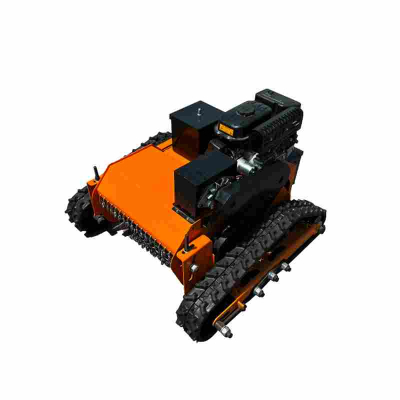
Specialized Remote-Controlled Mowers: The Ultimate Solution for Shrubland Clearing
As ecological management advances and land maintenance becomes more refined, shrubland clearing has emerged as a high-demand yet challenging scenario—characterized by dense vegetation, hidden obstacles, and harsh terrain. Traditional manual labor or general-purpose machinery often falls short in terms of safety, efficiency, and ecological compatibility. This article focuses on the unique pain points of shrubland clearing, systematically elaborates on the core advantages and scenario-specific technical configurations of specialized remote-controlled mowers, and provides a targeted equipment selection framework for B2B customers in industries such as ecological restoration, land management, and landscaping.
Operational Highlights
Dense growth of shrubs (3–10 cm in diameter) and stubborn weeds, undulating and concealed terrain, frequent presence of hidden obstacles (e.g., rocks, stumps, abandoned debris), and the need to balance clearing efficiency with minimal ecological disturbance.
Core Pain Points
Intense Cutting Demands: Requires high-strength, wear-resistant cutting systems to handle tough shrubs and fibrous weeds without jamming or damage.
Complex Obstacle Avoidance: Hidden obstacles and uneven terrain increase the risk of equipment collision and operator injury.
Safety Risks: Flying debris from cutting poses significant threats to on-site personnel; slope operations demand strong anti-rollover capabilities.
Ecological Compatibility: Needs to avoid excessive soil disturbance and preserve valuable native vegetation while clearing overgrowth.
II. Scenario-Specific Technical Configuration of Specialized Remote-Controlled Mowers
Tailored exclusively for shrubland clearing, the mower integrates high-performance components and intelligent design to address core challenges:
Power and Transmission System: Conquering High-Load Operations
Recommended Power Configuration: 30–40 kW high-torque gasoline engine (e.g., LOCIN420) or diesel engine, delivering robust power to tackle dense shrubs and sudden load impacts.
Transmission Design: Reinforced hydraulic motor + planetary gear reducer combination, ensuring stable power output and precise control even under heavy-load cutting.
Auxiliary Protection: Anti-entanglement chassis guards and reinforced gearbox housing prevent damage from debris and vegetation wrapping.
Cutting System: High-Strength and Adaptive Clearing
Cutting Module:550-1050mm
Core Technical Highlights:
- Manganese steel alloy flail blades for wear resistance and impact resistance
- way hydraulic obstacle avoidance (up/down, left/right, front/back) to buffer collisions
- size (≤5 cm) for uniform mulch coverage
- Contour floating design to adapt to uneven terrain
Operational Performance:
- Efficiently handles shrubs 3–10 cm in diameter
- Operational efficiency: 2–4 mu/hour
- can be directly returned to the soil to reduce erosion
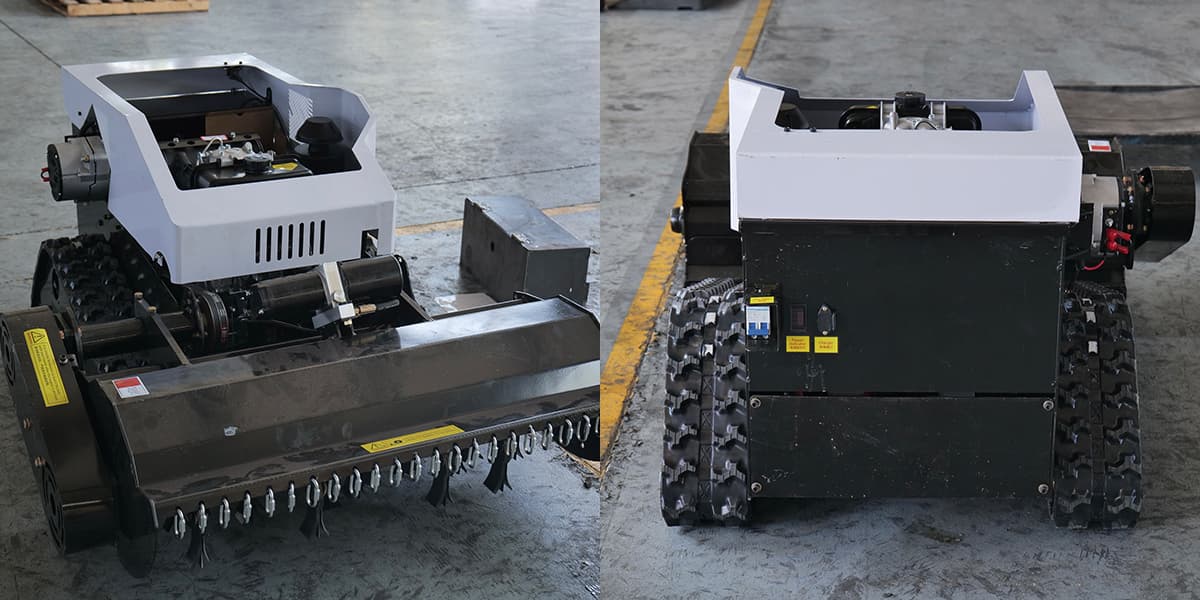
3. Travel System: All-Terrain Maneuverability
Track Configuration: Wide rubber tracks (width ≥400 mm) with deep tread patterns, providing strong traction on muddy, sloped, or uneven shrubland.
Ground Pressure Control: ≤25 kPa low ground pressure, avoiding soil compaction and protecting the ecological structure.
Suspension System: Central balance beam suspension, adapting to slopes of up to 40° and ensuring stable operation without rollover.
Additional Adaptability: 500 mm water-wading capability, suitable for humid or wet shrubland areas; operating temperature range of -20℃ to 55℃, adapting to diverse climatic conditions.
Complete human-machine separation eliminates operator exposure to flying debris, slope falls, and mechanical hazards.
Multi-layered safety protections (obstacle avoidance, slope control, emergency braking) reduce equipment failure and accident rates by over 60%.
High-torque power and adaptive cutting system significantly outperform manual labor and general-purpose machinery—reducing operation time by 70% and labor costs by 80%.
Low maintenance requirements and durable components lower long-term operational costs.
3. Ecologically Friendly
Mulch coverage technology reduces soil erosion by 70%, improving soil fertility and promoting ecological restoration.
Low ground pressure and precise cutting avoid damage to native vegetation and soil structure, aligning with ecological management goals.
4. Unmatched Adaptability
Conquers complex shrubland terrain (slopes, wetlands, uneven ground) that traditional equipment cannot handle, achieving full-area clearing without blind spots.
Safety Standards: From "risk exposure" to "absolute isolation" for operators.
Efficiency Logic: From "labor-intensive" to "intelligent, high-output" operations.
Ecological Impact: From "destructive clearing" to "restorative management" that balances efficiency and environmental protection.
For B2B customers facing shrubland clearing challenges, this specialized equipment delivers tangible value: reduced costs, enhanced safety, improved efficiency, and compliance with ecological management requirements—making it the ultimate choice for professional shrubland maintenance.